The journal
Walnut, rosewood, maple: wood on the espresso bench
Steel does the pressing on this bench, and wood does the holding. Three species carry our range, and they are not interchangeable in the hand or under a damp cloth. This is what each one is, on the authority of the people who measure wood for a living, and how to care for all of them.
Why wood at all
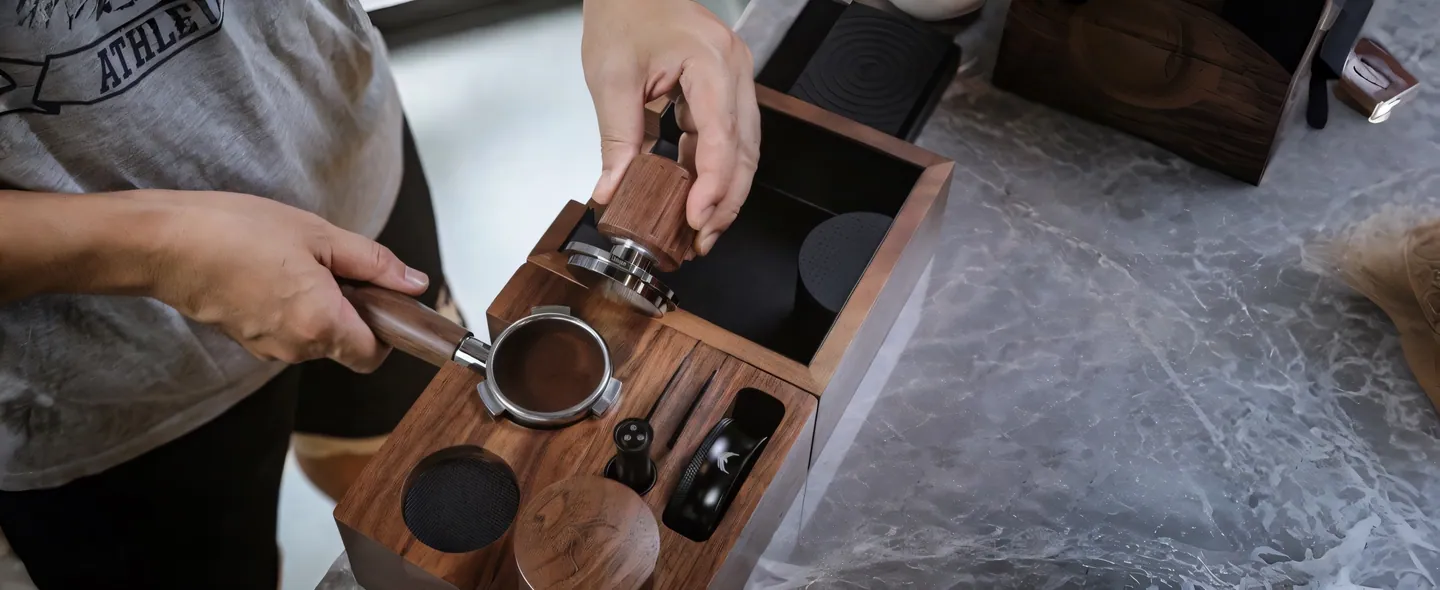
Every working face in this range is stainless steel: the tamper base, the distributor blades, the portafilter head, the funnel ring. Steel holds a machined edge, shrugs off coffee oil and rinses clean. What steel does badly is sit in a hand for thirty seconds twice a day. It starts cold, it stays heavy, and a polished cylinder offers fingers nothing to argue with. Wood is the opposite material: warm in a morning kitchen, light for its bulk, and shaped by the lathe into a knob or a handle your grip actually reads.
So the tools pair them. Steel where the coffee is, wood where you are, a threaded shaft joining the two. That pairing is the whole aesthetic of this brand, and it is also a set of practical choices about species, because "wood" is not one material. Our range is turned in three: walnut, the dark default, rosewood, the dense red one, and maple, the pale one. The differences between them are documented far beyond coffee, in the Forest Service's Wood Handbook, the reference the timber trade itself leans on, and its descriptions match what your hand will tell you.
Walnut, the quiet default
Walnut is the largest share of the range, and the reasons are in the handbook's own words.
Every clause of that sentence is a tool property. Straight grain means a handle without weak short-grain runouts. Easily worked means the lathe leaves a clean surface. Stable in use means the fit between wood and steel stays tight through seasons, and shock resistance is what a tamper handle absorbs a hundred times a week.Black walnut is normally straight grained, easily worked with tools, and stable in use. It is heavy, hard, strong, and stiff, and has good resistance to shock.
That is why our walnut is finished with oil rather than a thick film: the wood itself is the point, dark brown, straight-grained and matte, and an oil finish keeps it touchable while sealing the surface against splashes. On the bench it reads as furniture rather than equipment, which is precisely the register this brand aims for. If you want the safe answer, walnut is it, and most of our kits ship in it.Black walnut is well suited for natural finishes.
Rosewood, the dense one
Rosewood is the range's red-brown option, and it is a genuinely different material in the hand, noticeably heavier than walnut at the same size. The handbook is direct about the reason.
Density is what you feel: a rosewood tamper carries more of its own momentum into the press, which some baristas prefer the way some cooks prefer a heavy knife.Indian rosewood is a heavy wood with high strength properties; after drying, it is particularly hard for its weight.
Two more handbook lines explain why rosewood suits this job in particular.
Turning well is what makes the crisp coves and beads on our handles possible in so hard a wood, and screw-holding matters because every one of these handles lives on a threaded steel shaft. The figure is the visible reward: golden brown to dark purplish brown with near-black streaks, the strongest grain pattern of the three, glowing against polished steel. One honesty note belongs here, from the same page of the handbook: Indian rosewood is listed in CITES Appendix II, the treaty schedule for species whose trade is monitored, which is a fact about the species worth knowing when you buy anything made of it.The wood turns well and has high screw-holding properties.
Maple, the pale one
Maple is the light option, in both senses that matter on a dark counter: pale in colour and visually light against the steel. The handbook's description reads like a tool brief.
Fine, uniform texture is why maple takes the smoothest surface of our three. Hard and shock-resistant is why the same species is what cutting boards, flooring and tool handles have been made from for two centuries. The one caution in that sentence, high shrinkage, is about drying lumber, not finished handles: it is the reason maple is seasoned carefully before it is turned, and the reason a finished maple handle should not live in standing water, which is true of every wood on this page.Hard maple has a fine, uniform texture. It is heavy, strong, stiff, hard, and resistant to shock and has high shrinkage.
Choose maple when the bench should look lighter than it works: it shows honest wear sooner than the dark species, and pale wood against black machines is the strongest contrast this range offers.
Reading grain, since you will live with it
Grain is the visible record of how a tree grew, and on a turned handle it is both the decoration and the engineering. Straight grain means the wood fibres run the length of the piece, so the handle is strong along the axis you grip and twist. Figure, the shimmer and pattern collectors prize, is what happens when those fibres wave or curl, and the handbook notes it in maple specifically:
On a tamper handle, a little figure is jewellery. A lot of figure in the wrong place is short grain, fibres running across a thin section instead of along it, and short grain is where wooden things snap.The grain of sugar maple is generally straight, but birdseye, curly, or fiddleback grain is often selected for furniture or novelty items.
This is why boards for our handles are picked for tight, consistent grain first and looks second, and why the walnut carries its reputation:
Furniture and decorative panels is exactly the brief a tamping station lives under, a working object that is looked at a hundred times for every time it is picked up.Because of its good properties and interesting grain pattern, black walnut is much valued for furniture, architectural woodwork, and decorative panels.
Oil against film
Wood finishes divide into two families. Film finishes, the lacquers and thick varnishes, build a plastic shell over the surface: maximum protection until the shell chips, and then a visible scar that cannot be spot-repaired. Oil finishes soak into the surface and harden in it, protecting from within: less waterproof on paper, but renewable in minutes with a cloth and a drop of oil, with no shell to chip and no scar to show. For a tool handled wet-fingered every morning, the renewable finish is the right trade, and the handbook's line that walnut is well suited to natural finishes is the species-level agreement with that choice.
The practical consequence sits in the care section below: an oiled handle asks for thirty seconds of wiping now and a re-oil once or twice a year, and in exchange it never needs refinishing, never shows a chipped shell, and looks better at year three than at day one.
What water actually does to wood
Wood is hygroscopic: it takes on and gives up moisture with its surroundings, swelling as it absorbs and shrinking as it dries. A finished handle does this slowly and evenly, and nothing bad happens. Standing water is a different event: it enters end grain and joints far faster than it leaves, the wet region swells against the dry region next to it, and the stress finds the finish, the glue line or the wood itself. Repeat that cycle daily and a handle loosens or checks. This is the entire mechanism behind every rule in the care section, and it is why the dishwasher, which adds heat and detergent to the soak, is the one appliance that can undo a wooden tool in an afternoon.
The steel underneath
The wood gets the article, but half of every tool here is stainless steel, and the pairing is not decorative. Steel takes the machining that fit demands, holds the tamper's flat face and the distributor's planes to fractions of a millimetre, and shrugs off the acids and oils coffee leaves behind. Stainless asks nothing back: rinse, dry, done. Where a specification names the grade our pages carry it, and the joint between the two materials, a steel shaft threaded into the hardwood, is the one place both sets of rules meet, and the care advice keeps standing water away from exactly there for that reason.
The three, side by side
| Species | Colour and grain | Character in use |
|---|---|---|
| Walnut | Light to dark brown heartwood, normally straight grained | Heavy, hard, strong and stiff, good shock resistance, stable in use, suits natural finishes |
| Rosewood | Golden brown to dark purplish brown with darker streaks | Heavy with high strength, particularly hard for its weight after drying, turns well, holds screws well |
| Maple | Light reddish-brown heartwood, white sapwood, generally straight grain | Fine uniform texture, heavy, strong, stiff, hard and shock-resistant |
Characterisations from the USDA Forest Service Wood Handbook, chapter 2, read 11 August 2026. The full citation is on our sources page.
How the handles are made
The short version of the workshop story belongs in this guide because it explains the care advice that follows. Boards are chosen for tight, consistent grain, turned on a lathe, sanded through fine grits and finished with oil or sealants meant for daily exposure to water and coffee grounds, and steel shafts are threaded into the wood with tolerances that keep the joint firm. The longer version, including who does it, is on our about page. The care rules below all follow from that construction: the finish is thin by design, the joint is mechanical, and the wood underneath is wood.
Care: one habit, four surfaces
Wooden espresso tools fail one way: water. Not coffee, not oil from beans, not sunlight on a kitchen shelf, but standing water finding its way into end grain and joints. The habit that prevents it is the one printed on every product page of this site: wipe, do not soak.
After every session
Wipe the wood with a cloth that is damp, not wet, and dry it. Rinse the steel faces under warm water, dry them, and stand the tool in its place on the station rather than on a wet drip tray. Thirty seconds, and it is the whole daily routine.
Never
No dishwasher, ever: heat, detergent and an hour of steam attack the finish, the glue line and the wood itself, all at once. No soaking a wooden handle in the sink to loosen dried coffee: it softens with a damp cloth in a minute anyway. No storing a wooden tool wet in a closed drawer.
Over the years
An oiled finish is renewable, which is its quiet advantage over film finishes: when the wood starts to look dry, a drop of a food-safe mineral or hardwax oil, rubbed in and buffed off, restores it. Do it once or twice a year and a walnut handle will outlast the machine it serves. The steel asks even less: it is stainless, and a dry towel after rinsing is the entire specification.
Year three: how each one ages
New photographs sell tools, but you will own the third year, so it is worth describing. Oiled walnut deepens: the brown warms, the grain gains contrast, and the places your fingers land take on a low sheen that reads as character rather than wear. Rosewood, already the darkest and densest, changes least: its figure holds, its colour shifts slowly toward the dark end of its range, and its density keeps dents away. Maple tells the most honest story: pale wood shows the years soonest, darkening gently toward amber, and an occasional re-oil keeps the record even. None of these is damage. A wooden tool that looks lived-with beside a machine is doing what the material was chosen for, and the renewal routine above means the ageing stays graceful for as long as you keep the habit.
Questions this page usually answers
Which wood is most durable?
For the way these tools are actually used, all three are overbuilt: the handbook calls every one of them hard, strong and shock-resistant, and the working stresses live in the steel anyway. Rosewood is the hardest of the three for its weight, which matters at the margins, but the honest answer is that care habits decide a handle's lifespan and species decides its looks.
Can I re-oil with what is in my kitchen?
Use a food-safe mineral oil or a hardwax oil made for wooden kitchenware. Cooking oils are the wrong tool: most of them stay soft, go rancid in the grain, and leave the handle sticky. A small bottle of the right oil outlasts years of handles.
Can I sand out a mark?
A shallow mark in an oiled finish, yes: fine paper, with the grain, then re-oil the spot and feather it out. A film finish cannot be spot-repaired the same way, which is one more argument for the oil. Deep dents are wood that has moved, and steam tricks belong to furniture restorers; on a tool handle, the honest fix is to accept the biography.
Do the woods smell or taste of anything?
Finished and cured, no. The oil finishes on these handles are chosen for daily contact with hands and splashes of coffee, and the working faces, everything the coffee touches, are stainless steel in any case.
Choosing yours
If the bench is dark stone or black machinery, walnut disappears into it elegantly and maple stands out against it. On pale counters the logic flips. Rosewood is the choice when the tools should be the most figured object in the room. If you are assembling a full bench in one order, the kits keep all the pieces in a single species, and the size guide settles the only question that outranks looks. Whichever species you pick, it presses the same steel circle onto the same coffee, and the whole point of the preparation workflow is that the wood in your hand is the part you chose for pleasure.
Published 11 August 2026. Every source quoted here was read in full before it was quoted, and citations with read dates are on our sources page.