The journal
51, 54 or 58 mm: the group size guide
Every tool on this site is listed with a number in millimetres, and that number decides more than everything else on the page put together. This is what it measures, which machines run which size, and how to check yours before ordering anything.
The number that is really a diameter
Group size names the diameter of the coffee basket your machine brews through. The group head is the part of the machine the portafilter locks into, the basket is the perforated cup that holds the ground coffee, and the two are machined as a pair. A 54 mm basket is 54 millimetres across on the inside, and every tool that touches the coffee bed has to match it: the tamper face, the distributor base, the dosing funnel's collar, the puck screen resting on top.
The reason the fit is strict is what espresso does.
Pressure is exactly the thing that finds gaps. A tamper that is a size too small leaves a ring of loose grounds at the basket wall, water tears through that ring instead of the bed, and the shot runs fast, thin and sour no matter how carefully the middle was pressed. The trade calls it channelling, and an undersized tool builds the channel in before the water arrives.It uses high pressure to force nearly boiling water through finely ground coffee in about 20–30 seconds.
So the millimetre number on a tool page is not a specification detail. It is the first question, and it is the reason our machine finder asks about your machine before showing you anything else.
Three sizes carry the market
Espresso settled on a small set of basket diameters, and this range follows them. Across our 302 tools, 151 are 54 mm, 102 are 58 mm and 27 are 51 mm, which is a fair picture of the machines people actually own.
| Size | Where you meet it | In this range |
|---|---|---|
| 51 mm | Compact home machines, including many De'Longhi models | 27 tools |
| 54 mm | Breville home machines: Barista Express, Pro, Touch, Bambino | 151 tools |
| 58 mm | Prosumer and commercial machines, E61 group heads, Gaggia Classic | 102 tools |
Counts from the current catalogue. Every tool page states its own size next to the price.
58 mm, the commercial standard
Cafe machines and the prosumer machines built to their pattern run 58 mm baskets, and the E61 group head, the most copied piece of espresso hardware in existence, takes the same size. If your machine has an E61 group, a Gaggia Classic lineage, or anything described as commercial-spec, 58 mm tools are almost certainly what it needs. The 58 mm side of our range covers the whole bench: calibrated tampers, bottomless portafilters, distributors and WDT tools, funnels and puck screens and complete kits.
54 mm, the Breville home standard
Breville built its home espresso line around a 54 mm basket, and because those machines sold in enormous numbers, 54 mm became a standard of its own. The Barista Express, Barista Pro, Barista Touch and Bambino families all take it, and 164 tools in this range name Breville compatibility outright. It is the largest single group in our catalogue, and that is why so many of our kits are built as 54 mm benches.
51 mm, the compact machines
Smaller home machines, among them many De'Longhi models, brew through 51 mm baskets. The tools are the same ideas at a smaller diameter, and the range carries 27 of them, from tampers to full kits. If your machine came with a plastic tamper the diameter of an espresso cup, it is very likely a 51 mm machine.
How to check your size in two minutes
Manuals are vague about basket diameter surprisingly often, and the outside of the portafilter tells you nothing: the steel cup around a 54 mm basket can measure 57 or 58 mm across its outer lip. The measurement that decides the fit is the basket itself.
Take the portafilter out, knock the basket loose if it is held by a spring clip, and measure the inside diameter across the top of the basket with a ruler. You are reading the widest span of the opening, edge to edge through the centre. A 54 mm basket reads a whisker over 54, a 58 a whisker over 58. If the number lands near 51, 54 or 58, that is your size. Some machines ship with a size between the standards, and the section below is about exactly that.
If the ruler answer looks ambiguous, the machine model number settled it for someone before: the compatibility line on each of our tool pages lists the machine families the specification names, and the machine finder on the home page walks the same data from the other direction.
When half a millimetre matters, and when it does not
Two of the tools in this range are 58.5 mm and one is 57.5 mm, and those halves are not typos. Tampers are commonly sold a shade under their basket size so the edge does not scrape the wall on the way down: a "58 mm" tamper face often measures a fraction under its basket bore. Different makers slice this differently, so our product pages state the exact figure the specification gives rather than rounding it to the nearest standard.
The direction of the error is what decides whether it matters. A tamper slightly under the basket bore is normal and works. A tamper over it simply does not go in. A funnel or puck screen a touch under size still does its job, because neither is pressing the bed. So when a tool page says 58.5 mm, read it as "for 58 mm machines, cut generously" and check your basket if your machine is unusual. When in doubt, the basket measurement wins over every chart, including ours.
What the size changes in the cup
Diameter is geometry, and geometry reaches the flavour. Put the same eighteen grams of coffee into a 54 mm basket and a 58 mm basket and you get two different shapes: a taller, narrower column in the 54 and a wider, shallower disc in the 58. The water meets more surface at once in the wide bed and travels a shorter path through it, and the deep bed does the opposite. Neither is better, but they respond differently to the same mistakes. A shallow bed shows a distribution error faster, because a thin spot is a larger fraction of the whole depth. A deep bed hides the error longer and punishes it harder when the channel finally opens.
This is why prosumer culture grew up around 58 mm and obsesses over distribution tools, and why the home 54 mm machines come with more forgiving instructions. It is also why the basket capacity our product pages state, 18 to 21 grams on the bottomless portafilters, matters to more than maths: the dose that fills a 58 mm basket to the right depth is not the dose that fills a 54. When you change machines across sizes, you re-learn your recipe, and the scale in the scales department is how the re-learning stays short.
The depth of the bed also changes how hard the tools work. A wide 58 mm distributor plane has more surface to true, a 58 mm tamper carries a heavier head to keep the pressure per square centimetre in the same family, and the springs inside our calibrated tampers are chosen against the face area they press. The published calibrations across this range, 20, 25 and 30 pounds, land differently on a 51 mm circle than a 58 mm one, and that is one more quiet reason the tools are not interchangeable across sizes even when they physically fit the hand the same way.
Reading a tool page, line by line
Every product page on this site states the same short block of facts, and the size guide is the right place to say what each line is for. The group size line is this whole article in one number. The stated fit line lists machine families the manufacturer names outright, Breville or Gaggia or an E61 group, and it is a statement about the specification, not our guess. The materials line separates what touches coffee, stainless steel, from what touches you, the wood. Where a basket is included, its capacity is stated in grams, because a bottomless portafilter is bought around a dose.
Two honest limits of that block are worth knowing. First, a machine family is not a promise about every machine in it: revisions exist, and the basket measurement outranks the family name whenever the two disagree. Second, where the specification is silent, our page is silent too. A missing weight or a missing fit line means the maker did not state one, and we do not fill gaps with plausible numbers. The about page says this as policy; here it is as practice.
The five-minute pre-order checklist
Before ordering anything sized, run the list. Measure the basket, not the portafilter collar, and write the number down. Check the machine family line on the tool page against your machine's actual model name. If the tool includes a basket, check the capacity against the dose you actually pull. If you are buying several tools, buy them in one size and, if looks matter to you, one wood, which is the entire argument of the kits department. And if any of the four steps produced a surprise, stop and measure again before paying: the only expensive size mistake is the one that ships.
One bench, one size
The practical consequence of everything above: your bench should be bought in one size, and the tools were designed expecting it. The dosing funnel sits on the same basket the tamper presses, the puck screen lies on the bed the distributor levelled, and the portafilter stand is bored for the portafilter it holds. That is the logic of our kits department, where the tamper, station, funnel and screen arrive matched in the same wood and the same diameter, and it is the reason the kit pages list contents piece by piece rather than as a count.
It is also the reason we publish the size on every card in every department, next to the price rather than buried in a table.
Grind is the variable you tune every morning. Size is the one you settle once, on the day you buy the machine, and never think about again if the first purchase was right.As a general rule, the longer the coffee is in contact with water during the brewing process, the coarser the grind should be.
Questions this page usually answers
Can I use a 54 mm tamper in a 58 mm basket?
No. It will tamp a 54 mm circle in the middle of a 58 mm bed and leave a loose ring at the wall, which is the channelling scenario from the top of this page. The other direction, a 58 mm tamper into a 54 mm basket, does not fit at all.
My machine is not a Breville, a Gaggia or a De'Longhi. What now?
Measure the basket. The three standards cover most of the market, and the measurement takes less time than searching a forum. If your basket reads 58 and your machine is a prosumer or E61 design, the 58 mm range fits. The compatibility lines on each product page list every machine family the manufacturer names.
Does the wood change the size?
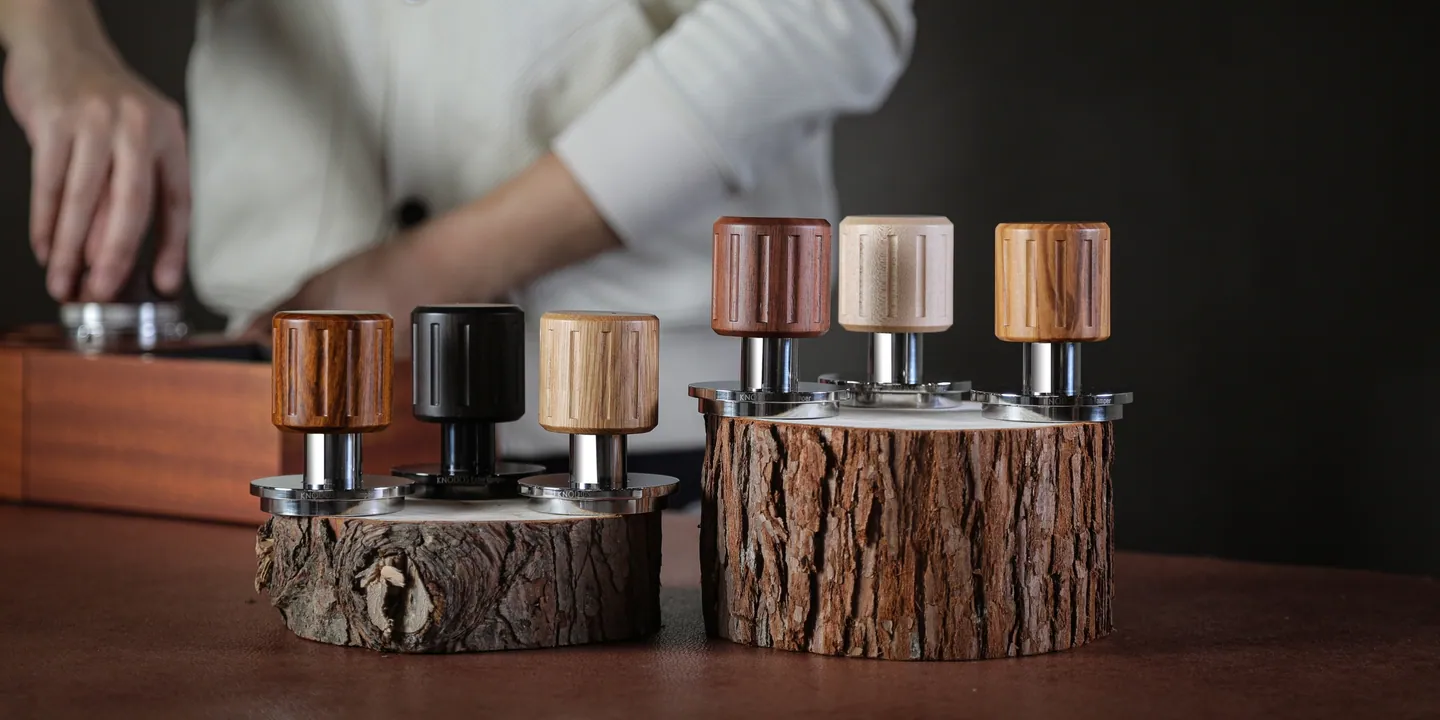
Never. The wood is the handle, and the working faces are stainless steel, machined to the stated diameter. A walnut and a rosewood 54 mm tamper press exactly the same circle, so choosing between them is a question for our wood guide, not this one.
Are all Breville machines 54 mm?
No, and this catches people. The home line, Barista Express, Pro, Touch and Bambino, runs 54 mm, but Breville's upper tier is built to the commercial standard: the specification lines in our own range name the Dual Boiler, the Oracle and the Oracle Jet as 58 mm machines. If your Breville is one of those, you shop the 58 mm shelf. The model name on the machine settles it, and the basket measurement settles the model name.
Do dosing funnels and puck screens need the same precision as tampers?
Less. A tamper presses the bed, so its face has to sweep the basket wall closely. A funnel only guides grounds in, and a screen only lies on top, so a touch of clearance costs nothing. That is why a single 54 mm funnel serves every 54 mm machine happily while tamper faces are machined to fractions. Buy them in your size and stop worrying at the half millimetre.
Is a bigger basket better?
It is different, not better. A 58 mm bed is wider and shallower for the same dose, which many people find more forgiving to distribute, and a 54 mm machine makes excellent espresso with the same care. The best size is the one your machine already is. The tools' job, whatever the diameter, is the one described in our puck preparation guide: an even bed, a level press, clean water contact.
What about the sizes this range does not carry?
Espresso history is littered with other diameters, 49 mm lever machines and 53 mm portafilters among them, and owners of those machines learn their sizes the same way: measure the basket. Our range concentrates on the three standards because that is where the machines are. If your measurement lands somewhere else entirely, no chart on this site will fit you better than a ruler already has.
Published 11 August 2026. Every source quoted here was read in full before it was quoted, and citations with read dates are on our sources page.